Environmental Report 2025
Measures to Address Climate Change
Climate change is a critical global issue that requires further strengthened efforts worldwide.
The JAE Group in Japan is addressing climate change through three pillars: environmental awareness training, production-related measures, and measures at plant facilities.
Greenhouse Gas (GHG) Emissions of the JAE Group
In fiscal 2024, the JAE Group’s GHG emissions were 38,434 t-CO2, representing a 64% reduction compared to fiscal 2017.
This reduction was achieved through the introduction of renewable electricity at HAE, YAE, SAE, FAE, MGC, and JAE (including NLC), as well as through energy conservation activities across the Group.

Energy intensity (t-CO2/100 million yen) is calculated based on total GHG emissions in Japan and overseas divided by consolidated net sales.
The conversion factors for CO2 emissions from domestic electricity use are based on the values published by each power company in the Ministry of the Environment’s list of calculation methods and emission factors.
In fiscal 2023, we also set new GHG reduction targets (covering Scope 1 and Scope 2 emissions at domestic and overseas production sites). Going forward, we will continue our efforts to achieve carbon neutrality by 2050.
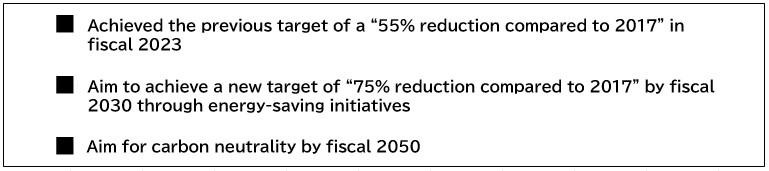
As a Groupwide activity that includes overseas production sites, we will continue to monitor our electricity consumption, greenhouse gas emissions, and emissions per sales unit, while further promoting energy savings in infrastructure and production equipment, efficient production, and the introduction of renewable energy. Starting in fiscal 2022, we have doubled the previous energy-saving targets and implemented energy-saving measures at each production site, as illustrated in the examples below. Last year, we also received an energy-saving diagnosis from external experts, and we will continue promoting energy conservation.
Regarding the introduction of renewable energy, we switched to 100% renewable energy-derived electricity at four domestic production sites and NLC, and installed the following solar power generation system on the rooftop of the JAE Akishima Plant in 2024. The results of its operation will be used to determine the feasibility of introducing similar systems at other sites.
Status of response to SBT
The JAE Group had received SBTi 1.5°C certification as part of the NEC Group. However, as of March 22, 2024, the JAE Group changed its status from a consolidated subsidiary of NEC Corporation to an equity method affiliate, and will actively pursue obtaining SBT certification as the JAE Group.Status of progress toward uniform goals in the electrical and electronics industries
The JAE Group in Japan participates in the electrical and electronics industries’ Action Plan for Carbon Neutrality and is progressing toward the goal of a 1% annual average energy efficiency improvement in production processes through 2030.We will continue to curb energy usage per unit by taking steps to contribute to energy savings.
Status of Response to Tokyo Cap-and-Trade Program
In the third planning period from fiscal 2020 to fiscal 2024, an average reduction obligation of 25% was imposed. However, due to factors such as the launch of new products, the overall reduction did not reach the required 25% below the baseline emissions. Accordingly, the reduction obligation will be fulfilled through the use of Tokyo Renewable Energy Credits. For the fourth planning period beginning in fiscal 2025, we will further strengthen our climate change measures, including energy conservation and the introduction of renewable energy.
Contribution of the JAE Group Forest
The Group has estimated that the amount of greenhouse gases (CO2) absorbed through the planting of Japanese cypress and broadleaf trees in the JAE Group Forest is about 5.3 tons-CO2 per year.Fiscal 2024 Energy Conservation Case Studies
Plants and related facilities and production system
| Implementation Details (1) | ||
| Power Reduction through Replacement of Factory Transformer (JAE) |
Energy consumption was reduced by replacing a factory transformer used in production with an amorphous transformer. | |
| Effect | Notes | |
| Approx. 36,738 kWh/year |
― |
|
| Implementation Details (2) | ||
| Power Reduction in Gold-deposition Stripping Equipment (HAE) |
In continuous plating of very small parts, jigs are used to control solution volume. Over prolonged use, a small amount of metal precipitates on the jigs, which can adversely affect the plating film, requiring periodic stripping. Conventionally, the stripping solution was heated and the jigs immersed, with chillers and temperature controllers consuming significant power to raise and maintain the solution temperature. The company internally developed and evaluated a stripping solution that provides the same performance (stripping time) at room temperature as the heated type. This allows operation without a chiller or temperature control. | |
 |
Effect | Notes |
| Approx. 19,640 kWh/year |
― | |
| Implementation Details (3) | ||
| Energy Saving through Automatic Control of Compressor Operation (YAE) |
The air used in the factory is generated by multiple compressors, stored in a receiver tank, and then supplied throughout the facility. Previously, each compressor had to be manually switched on and off, which sometimes resulted in excessive air generation and wasted energy. By installing a control panel for automatic adjustment of the number of units in operation, the system now operates only the compressors required to meet demand in real time, thereby eliminating excessive air generation and achieving significant power savings. | |
 |
Effect | Notes |
| 1,818,175kWh /year |
― | |
Lighting Improvements
| Implementation Details (1) | ||
| Switched to LED lighting (JAE) |
|
|
 |
Effect | Notes |
| Total of 81,640 kWh/year |
Building lighting has been systematically converted to LED since fiscal 2013. We plan to continue systematically replacing outdated lighting, focusing on the welfare office building and Factory No. 1 floors. As of the end of fiscal 2024, 9,185 out of 11,507 lights had been converted to LED (progress rate: 80%). |
|
Activities at Overseas Production Sites
| Implementation Details (1) | ||
| Energy-saving Initiatives at JAE-WJ Power supply to the lighting system using solar power on the factory building rooftop  Charging electric vehicles (two-wheelers) using solar power.  |
Introduction of solar power generation
|
|
| Effect | Notes | |
|
Total 44,122.7kWh /year
|
ー | |
Logistics related
1) CO2 reductions from modal shift (railway transport)
Reduced CO2 emissions by switching from truck transport (crates) to railway transport (containers)
CO2 reduction in fiscal 2024:
2.337 tons (compared to truck transport)

2) CO2 emissions reductions by using reusable trays
We reduced CO2 by reusing connector trays.
The CO2 reduction in fiscal 2024:
112.263 tons.
*40.675 tons of reusable trays/year x conversion factor of 2.76 t-CO2 = 112.263 t-CO2

Activities to Increase Awareness of Measures to Fight Climate Change
Introduced here are several fiscal 2024 efforts made to increase awareness of climate change measures.Environment Month publicity and a wide range of Environment Month activities were held at each site.
- Eco-driving training
- Clean-up campaign around each work site, and other activities
All employees of the JAE Group in Japan took part in e-learning.
(For details, see the Environmental Education section) (click to open)
● Cool Biz and Warm Biz: Domestic JAE Group
- Cool Biz (May 1 through October 31 [e.g., period at JAE])
- Warm Biz (December 1 through March 31 [e.g., period at JAE])
Measures to Fight Climate Change through Supply Chain Cooperation
The JAE Group asks its domestic business partners to agree to and implement greenhouse gas emission reductions in line with its CSR guidelines, and it is taking measures to address climate change throughout the supply chain.Building a Sustainable World
Significance of the 2025 Environmental Report
Symbol of the Group's Environmental Policies
Scope of Reporting and Editorial Policy
Policies and Results of Environmental Activities
Environmental Management
- Implementation Status of the Environmental Management System
- Environmental Audits
- Environmental Education
- Environmental Risk Management
- Environmental Accounting
Engaging with Society
- Involvement with Biodiversity
- Supply Chain Management
- Eco-friendly Products
- Social Contribution Activities
Initiatives to Reduce Environmental Impact